

Views: 0 Author: Site Editor Publish Time: 2026-08-28 Origin: Site


Construction delays cost money, but low-light conditions actively threaten lives. As daylight hours shrink during seasonal shifts, site managers face a critical operational bottleneck. Night shifts become mandatory to keep tight project timelines on track. However, working in the dark drastically increases safety hazards. It also makes regulatory compliance exceptionally difficult. You simply cannot afford blind spots on a busy, hazardous job site. We must position the lighting tower as more than a simple luminaire. It acts as a primary risk-mitigation and productivity tool. You need it to maintain continuous operations safely. Selecting the right unit goes well beyond flipping a switch. You must carefully balance strict illumination requirements against fuel efficiency, ease of mobility, and varying environmental constraints. Finding the perfect fit ensures your crew stays completely safe while pushing the project forward. Read on to discover how modern illumination transforms late-night site management effectively.
To keep infrastructure deadlines from slipping, many projects rely heavily on 24/7 operational cycles. Engineered lighting allows your crews to work seamlessly through the night. Using robust construction lighting equipment ensures productivity never drops when the sun finally goes down. Proper illumination creates a highly visible, daytime-like environment. This helps teams maintain their standard pace without hesitation or guesswork.
Furthermore, reliable illumination directly impacts site safety and risk mitigation. Construction zones remain inherently dangerous around the clock. Heavy shadows hide dangerous trip hazards. They obscure the crucial turning radius of heavy machinery. Fatigue-related errors also spike dangerously during night shifts. Adequate lux levels reduce measurable incident rates significantly. Bright, even lighting minimizes visual strain for everyone. Your operators can see physical obstacles clearly and react much faster.
Beyond active working hours, consistent lighting provides immense security advantages. Idle equipment and expensive raw materials attract theft overnight. Unauthorized site access poses a massive financial liability. A brightly lit site naturally deters trespassers. It makes surveillance cameras much more effective. Security patrols can easily spot anomalies from a safe distance.
Different project phases demand highly distinct lighting strategies. Let us explore the core applications across various civil and commercial developments.
Working on live highways introduces extreme risks. You need highly directional, glare-free light. It protects your active workers on the asphalt. It also prevents blinding the passing drivers. Work zones shift rapidly along the highway as paving continues. Therefore, utilizing a mobile lighting tower becomes an absolute necessity. Crews can hitch these compact units to utility trucks. They reposition them effortlessly as the paving machinery progresses forward.
Early-stage site development requires broad, wide-area floodlighting. Excavators, bulldozers, and dump trucks possess massive turning radii. They also suffer from notorious blind spots. Proper floodlights eliminate deep shadows across highly uneven terrain. Operators gain full spatial awareness. They avoid costly collisions and navigate steep slopes safely.
Large commercial concrete pours often happen late at night. Cooler nighttime temperatures prevent the chemical mixture from curing too quickly. During this crucial phase, lighting must be perfectly uniform. Finishers rely entirely on visual cues to spot structural defects. Uneven lighting can easily hide trowel marks or improper grading. Flawless illumination ensures the final curing quality meets strict engineering standards.
Off-grid environments present unique logistical challenges. You cannot rely on municipal power grids in remote areas. Integrated generators become critical lifelines. They power the high-intensity light arrays while also providing auxiliary electricity. Crews use this localized power source to run essential hand tools and mobile offices.
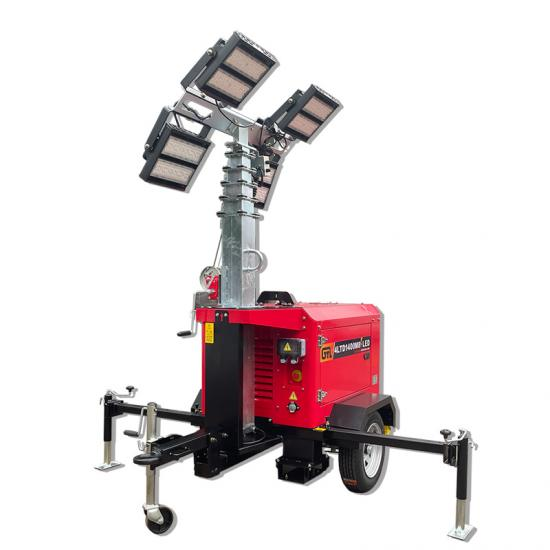
Selecting the correct power source heavily influences site efficiency. You must successfully match the technology to your specific operational environment.
A modern diesel lighting tower offers unmatched historical reliability. They deliver impressively extended runtimes. Many contemporary units exceed 100 hours of continuous operation on a single tank. Built-in generator capabilities provide essential auxiliary power for remote locations. However, they carry specific drawbacks. You must actively account for ongoing fuel logistics. Strict urban emissions compliance regulations can aggressively restrict their use. Noise pollution also limits their overnight deployment in dense residential neighborhoods.
Solar arrays paired with modern lithium battery banks offer compelling benefits. They operate in complete silence. This makes them absolutely ideal for residential noise ordinances. Routine maintenance requirements are incredibly low. They also eliminate diesel fuel consumption completely. But distinct risks still exist. They rely heavily on favorable weather conditions to recharge. Upfront capital expenditure is generally higher than traditional models. Furthermore, battery cell degradation accelerates rapidly in extreme heat or freezing winter temperatures.
The construction industry has largely shifted away from legacy metal halide bulbs. High-efficiency LED modules now serve as the dominant modern standard. Here is exactly why this transition happened:
Procuring a highly effective outdoor lighting solution demands careful technical evaluation. Do not simply look at total raw lumens. You must thoroughly analyze several structural and operational dimensions.
High lumen outputs mean very little if the light simply scatters into the night sky. You must evaluate the total effective coverage area on the ground. Measure your actual performance in lux per square meter. Light uniformity matters tremendously. Intense bright spots surrounded by dark peripheral zones cause severe operator eye fatigue. Seek specialized fixtures engineered specifically for smooth, completely even distribution.
The physical structure directly determines site safety and light coverage footprint. Analyze the documented operational limits carefully.
Assess the underlying chassis design. The equipment must move seamlessly between varied work zones. Can you tow it safely at standard highway speeds? Does it feature rugged, all-terrain tires for deep mud? How easily can a single operator maneuver it manually once disconnected from the truck? These factors determine daily operational agility.
| Evaluation Category | Key Features to Assess | Desired Field Outcome |
|---|---|---|
| Illumination Quality | Lux density, uniformity, glare shields | Even ground coverage without dangerous blind spots |
| Structural Stability | Outrigger design, maximum wind rating | Safe, uninterrupted operation in severe weather |
| Mast Operation | Hydraulic vs. manual winch systems | Quick, safe, and strain-free vertical deployment |
| Chassis Mobility | Axle load rating, DOT-approved hitches | Highway-safe transportability between different sites |
Even the absolute best equipment fails if deployed incorrectly. You must understand the harsh realities of active job sites. Strategic positioning determines the ultimate effectiveness of your setup. We recommend utilizing a clear framework for placement. Never point heavy floodlights directly into oncoming traffic lanes. Do not blind heavy equipment operators in their enclosed cabins. Instead, angle the fixtures slightly downward. Employ deliberate cross-lighting techniques. Placing two units at opposite corners reduces heavy shadows. This creates a highly uniform, highly safe work zone.
You must also anticipate serious maintenance roadblocks. Construction environments are incredibly dusty and dirty. The nearby machinery vibrates constantly. Because of these incredibly harsh conditions, you need robust engineering. Insist on IP-rated sealed lamp casings. They successfully prevent microscopic dust ingress. Ensure the primary engine compartments remain highly accessible. Technicians need rapid access to physical filters and engine fluids during tight turnaround times.
Finally, apply sound shortlisting logic to your acquisition strategy. The classic "Rent vs. Buy" decision requires careful thought. Assess your overall project duration. Consider your fluctuating seasonal lighting needs. Fall and winter surges often justify temporary rentals. Conversely, multi-year infrastructure developments easily warrant permanent capital purchases. Evaluate your off-season storage capabilities honestly. Leaving idle units fully exposed to harsh winter elements accelerates mechanical wear rapidly.
Securing the right illumination equipment drastically improves nocturnal site operations. It meticulously aligns your specific project demands with the appropriate mechanical technology. Remote off-grid locations require heavy-duty integrated power generation. Dense urban zones demand silent, completely emission-free operation. Highly mobile paving crews absolutely need towable, rapid-deployment chassis designs. You must match the specific tool to the exact environment.
Take immediate action before scheduling your next major night shift. Encourage your site managers to conduct a comprehensive site lighting audit. Consult directly with a technical illumination specialist today. They can calculate your exact structural footprint requirements. Doing this prior to procurement prevents incredibly costly missteps. Protect your entire crew effectively and keep your project timelines highly aggressive.
A: The exact number depends heavily on your required lux levels. General clearing operations may only need 5 lux. However, detailed tasks like concrete finishing often require 20 lux or more. You must also consider the maximum illumination footprint of your specific model. We strongly suggest performing a detailed site map analysis to calculate overlapping light zones and ensure complete coverage.
A: You can expect a realistic range between 0.5 to 1.5 liters per hour. This variance depends entirely on engine efficiency and the load demanded. Modern LED arrays draw significantly less power than older metal halide bulbs, dropping fuel usage. Additionally, pulling auxiliary power for hand tools or trailers will push fuel consumption toward the higher end of that range.
A: Yes, they certainly can. Commercial-grade units feature heavily stabilized outriggers. They carry strict wind-load ratings, typically certified to remain upright in 50 to 65 mph winds. However, standard safety protocols dictate that operators should lower the masts completely during extreme gales or hurricane warnings to prevent catastrophic structural failure.
A: Deployment speed depends on the mast mechanism. Traditional manual winch masts are somewhat slower and labor-intensive. They take a few minutes of physical cranking. Conversely, hydraulic masts offer rapid convenience. A single operator can safely raise a hydraulic mast to its full height in under three minutes simply by pressing a button.


