

Views: 0 Author: Site Editor Publish Time: 2025-12-18 Origin: Site


Have you ever wondered how work continues seamlessly through the night in construction or emergency scenarios? The solution is a light tower. These mobile lighting solutions ensure safety and productivity, even in areas without reliable access to power.In this article, we’ll explore how light towers work, the different types available, and how to choose the right one for your specific needs. You’ll learn about the importance of light towers for nighttime operations and how they improve safety and efficiency.

A light tower is a piece of mobile equipment designed to provide temporary illumination. It consists of a base, a mast, and lamps, often powered by a generator or an alternative energy source like solar panels. These towers are mounted on trailers, allowing them to be moved easily between job sites and positioned to illuminate large areas effectively.
Here is the detailed table of the key components of a light tower, designed to present professional terms, specifications, and data clearly for both experts and general users:
| Component | Function | Key Features | Common Technical Specifications | Applications |
|---|---|---|---|---|
| Base | Provides power and supports the entire light tower structure | - Typically powered by a diesel engine, petrol engine, or a combination of solar panels and battery packs- Adapts to various power needs | - Diesel Engine: Power range from 5kW to 20kW- Solar System: Typically provides about 8 hours of lighting based on battery capacity | - Construction sites- Emergency rescue- Off-grid areas |
| Mast | Supports the lamps and provides optimal height for light distribution | - Often extendable to adjust height- Some models are collapsible for easy storage and transport | - Max Height: Typically 6-12 meters- Extendable Function: Can be raised to maximum height and retracted quickly | - Large construction projects- Outdoor events- Emergency repairs |
| Lamps | Provide illumination to ensure large areas are adequately lit | - Uses high-wattage bulbs like LED, metal halide, or sodium lamps- Produces bright, clear lighting suitable for various environments | - LED Lamps: Power range from 100W to 1500W- Metal Halide Lamps: Typically 1000W to 2000W- Sodium Lamps: Common power from 400W to 1000W | - Nighttime construction- Movie sets- Large events |
Tip: When selecting a light tower, consider the lighting needs of the site, expected usage duration, and power availability to choose the appropriate power source, lamps, and height settings.
Light towers work by using a generator or other power sources to supply electricity to the lamps mounted on the mast. The power is typically generated through combustion engines (diesel or petrol), solar energy, or electric batteries, which then power the lamps to light up vast areas. The generator ensures that the light tower can function independently, even in remote locations without a direct electricity supply.
Here is a detailed table comparing Diesel-powered, Solar-powered, Electric, and Hybrid Light Towers, including technical specifications and key features:
| Type of Light Tower | Power Source | Key Features | Common Technical Specifications | Applications |
|---|---|---|---|---|
| Diesel-powered Light Towers | Diesel Engine | - High fuel efficiency- Long operational hours without frequent refueling- Reliable in remote areas without grid power | - Fuel Tank Capacity: 50-200 liters- Runtime: 60-100 hours per tank- Power Output: 5kW to 20kW | - Construction sites- Remote areas- Emergency services |
| Solar-powered Light Towers | Solar Panels + Batteries | - Eco-friendly- Low operational costs- Limited runtime based on solar charging | - Battery Capacity: 100-500Ah- Lighting Duration: 8-12 hours (depending on sunlight availability)- Solar Panels: 100W to 500W | - Areas with abundant sunlight- Environmentally conscious projects- Temporary outdoor events |
| Electric Light Towers | External Grid Power | - Convenient for sites with access to electrical grid- No need for refueling- Silent operation | - Power Requirement: 110V-240V- Lighting Duration: Unlimited (depends on grid availability)- Power Output: 1kW to 10kW | - Sites with grid power access- Indoor operations- Urban settings |
| Hybrid Light Towers | Diesel + Electric or Solar | - Combines diesel and electric sources for flexibility- Reduced fuel consumption- Can operate on battery when diesel is not needed | - Battery Capacity: 100-500Ah- Power Output: 5kW to 20kW- Fuel Tank Capacity: 50-150 liters | - Construction sites with varying power needs- Eco-friendly projects- Long-duration operations |
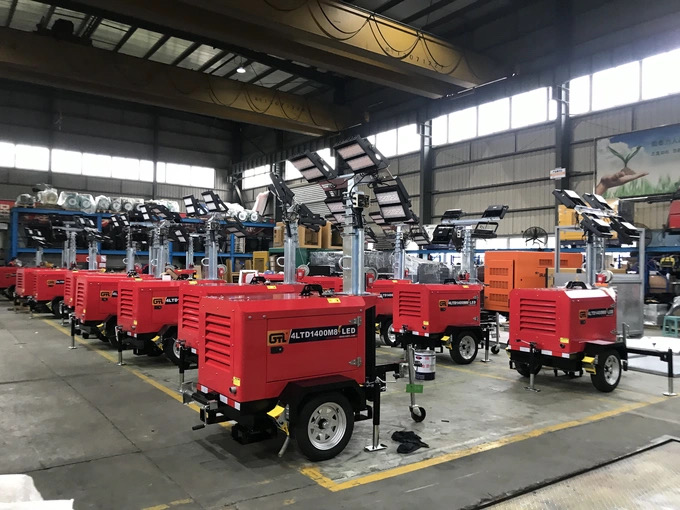
Light towers are indispensable on construction sites, enabling workers to continue operations safely at night. They provide high-intensity lighting that improves visibility, reduces the risk of accidents, and helps maintain productivity. With lighting that can cover large areas, light towers help meet project deadlines by keeping work on schedule, even in low-light conditions.
In emergency situations like natural disasters, light towers offer essential illumination to rescue teams operating in remote or power-limited areas. They enhance safety and visibility, allowing for faster and more efficient search-and-rescue missions. Light towers also ensure a reliable light source, making it easier for rescuers to navigate hazardous environments and provide aid to victims.
For outdoor events like festivals, concerts, and sports competitions, light towers are crucial for setting the right atmosphere and ensuring safety. They provide powerful illumination that covers large venues, enhancing visibility for both performers and attendees. Their portability and high brightness make light towers a practical solution for temporary lighting needs, ensuring smooth operations throughout the event.
Light towers are essential for road repair and maintenance, providing bright, consistent lighting in areas where streetlights are unavailable or insufficient. They enable workers to carry out tasks like paving, lane markings, and repairs during nighttime or low-visibility conditions. With light towers, roadwork can continue safely, minimizing traffic disruption and ensuring projects are completed on time, even in dark or adverse weather conditions.
When selecting a light tower, it’s crucial to consider factors like the area of coverage, portability, and the power source. These elements directly impact the effectiveness, mobility, and cost efficiency of the light tower.
| Factor | Description | Key Considerations | Typical Specifications | Applications |
|---|---|---|---|---|
| Area of Coverage | Determines the required mast height and lamp wattage based on the size of the area to be illuminated. | - Larger areas require higher masts and high-wattage bulbs for proper coverage.- Light intensity must be sufficient to avoid shadows and ensure full illumination. | - Mast Height: 6-12 meters for large areas- Lamp Wattage: 1000W to 2000W per lamp | - Large construction sites- Outdoor events- Sports stadiums |
| Portability | The ease with which a light tower can be moved between locations. | - Light towers should have sturdy wheels for easy transport.- Lightweight and compact designs improve mobility. | - Weight: 200kg to 500kg- Wheel Type: Heavy-duty wheels with a locking mechanism for stability | - Temporary work sites- Emergency response- Movie sets |
| Power Source | The power source affects cost, environmental impact, and operational flexibility. | - Diesel-powered towers are ideal for remote areas with no access to grid power.- Solar and electric models are better for eco-friendly projects with easy grid access. | - Diesel: 5kW to 20kW, 60-100 hours runtime- Solar: 8-12 hours runtime based on sunlight- Electric: Unlimited runtime with grid access | - Remote areas (Diesel)- Sustainable projects (Solar)- Urban construction (Electric) |
Tip: Choose a light tower based on area size, portability, and available power sources to ensure optimal performance and cost-efficiency.
Consider the fuel efficiency and operational costs of the light tower. Diesel models may offer more extended runtime but come with higher fuel costs, while solar-powered models may have higher upfront costs but lower operational expenses. Evaluate the best fit for your project based on both performance and budget.
Portable light towers offer flexibility, allowing them to be easily moved from one job site to another. This makes them ideal for temporary projects or environments where lighting needs change frequently. They are compact and can be set up quickly, making them highly versatile.
Fixed light towers are typically used for long-term lighting solutions in areas that require constant illumination. These are usually found in parking lots, construction sites, and similar locations where the lighting infrastructure is required to remain in place for extended periods. Fixed towers are less mobile but can offer more stable, high-powered illumination.
Industry certifications ensure that light towers meet rigorous safety, performance, and quality standards. These certifications validate the equipment's durability, energy efficiency, and overall reliability. By adhering to these standards, certified light towers reduce the risk of breakdowns, prevent costly downtime, and help businesses maintain consistent operations, ultimately leading to increased productivity and cost savings over time.
Certifications like CE, UL, and EPA cover various essential aspects such as safety, performance, and environmental responsibility. For example, EPA certification ensures that diesel-powered light towers meet stringent emissions standards, reducing harmful pollutants. These certifications not only guarantee compliance with regulations but also confirm that the equipment operates efficiently and safely, minimizing environmental impact and ensuring long-term reliability.
Third-party testing ensures light towers meet industry standards for performance, longevity, and environmental impact. Independent evaluations verify light intensity, fuel efficiency, and structural integrity, offering additional reliability and helping users trust that the equipment will perform effectively in real-world conditions.
Light towers are essential for providing reliable illumination during nighttime operations in industries such as construction, emergency response, and outdoor events. Choosing the right light tower, based on factors like portability, power source, and area coverage, is crucial to ensuring safety and efficiency. Xiamen GTL Power System Co., Ltd. offers a range of high-performance light towers designed to meet various operational needs, helping businesses stay on schedule and enhance productivity with reliable, cost-effective lighting solutions.
A: A Light Tower is a portable lighting solution used to provide illumination in outdoor areas when natural light is insufficient. It consists of a base, mast, and lamps, powered by various energy sources.
A: A Light Tower uses a power source, such as a diesel engine or solar panel, to generate electricity. This power is used to illuminate lamps mounted on the mast, providing lighting for large areas.
A: Light Towers offer reliable lighting for nighttime operations. They improve safety, reduce downtime, and ensure productivity in construction, emergency services, and outdoor events.
A: Diesel-powered Light Towers can run for 60 to 100 hours on a full tank, depending on the model and the power output. Solar and electric models may require recharging after several hours.


